Spaced Repetition, Done Properly: What the Research Actually Says
by Braintiq Academic Team
There is a finding in learning research that has held up for over a century, across ages, subjects and testing formats, and it is almost the opposite of how most people study.
Spreading practice out beats massing it together, even when the total time spent is identical. Not slightly. Substantially, and the advantage grows the longer the delay before the final test.
The effect has a name, the spacing effect, and it goes back to Hermann Ebbinghaus in the 1880s. What is more useful than the history is understanding why it works, because once you understand the mechanism you stop fighting it.
Why cramming feels better and works worse
Read a page four times in one sitting and you will feel you know it. That feeling is real and it is measuring the wrong thing. It is measuring how available the material is right now, while it is still active in your mind, which is a poor predictor of whether you can produce it in three weeks in an exam hall.
Spread those four readings over two weeks and each one feels harder. You will have forgotten some of it. You will have to reconstruct.
That reconstruction is the point. Retrieving something that has partly faded strengthens the memory far more than re-reading something still fresh. Cognitive scientists call the general principle desirable difficulty: conditions that make practice feel harder and produce better long-term retention.
The trap is that we judge our study by how it feels while we are doing it. Massed practice feels fluent and produces weak memory. Spaced practice feels effortful and produces durable memory. Students very reasonably choose the one that feels like it is working.
The second half: retrieval, not review
Spacing tells you when to study. It does not tell you how, and the how matters just as much.
Re-reading notes is one of the most common study methods and one of the least effective. Highlighting is worse, because it adds the feeling of activity to the passivity of reading.
What works is retrieval practice: trying to produce the answer from memory before checking. Close the book and write down everything you remember about a topic. Answer a question from a past paper without notes. Explain a concept out loud to nobody.
The act of struggling to retrieve is what strengthens the trace. Looking at the answer does very little on its own, which is why reading a worked solution produces a strong feeling of understanding and almost no ability to produce one yourself later.
Combine the two and you have the method: retrieve, spaced out over time.
A schedule that actually works
You do not need an algorithm. Expanding intervals are enough, and something like this is well supported:
- First review: one day after learning it
- Second: three days later
- Third: one week later
- Fourth: two weeks later
- Fifth: one month later
If you get something wrong at any point, shorten the next interval rather than continuing to expand. If something is consistently easy, stretch it further. The intervals are a starting point, not a prescription.
For a South African student, the practical shape of this is: review today's lecture tomorrow, again at the weekend, again the following weekend, and then it joins a monthly cycle until the exam. That is far less work than it sounds, because each review is short. A review is not a study session. Ten minutes is normal.
What to actually do in a review
The mistake is to review by re-reading. A review should be a test.
Blank page recall. Write the topic at the top of an empty page and write everything you can remember. Then open your notes and add, in a different colour, what you missed. The different colour matters: over several reviews, the coloured additions show you exactly where your gaps persist.
Worked problems from memory. Cover the solution. Attempt it. Uncover one line when stuck, cover it again, continue.
Explain it out loud. If you cannot explain why a negative exponent means reciprocal, or why a catalyst does not change the yield, you do not know it yet, however familiar it feels.
Past paper questions cold. No notes, timed. This is the highest-fidelity version of retrieval practice available, because it matches the conditions you will be tested under.
Where flashcards fit, and where they do not
Flashcards are a good implementation of spaced retrieval and a bad implementation of understanding.
They work well for things that are genuinely atomic: definitions, formulas, the reasons list in Euclidean geometry, functional groups in organic chemistry, the conditions under which a theorem applies. These are facts with clean boundaries, and drilling them is exactly right.
They work badly for multi-step procedures. A card reading "how do you do integration by parts" cannot be meaningfully self-marked, because the answer is a process and you will award yourself the mark for recognising the shape of it. That is a false positive, and false positives are worse than no practice, because they remove the topic from your review list.
The rule: if the answer fits on the back of a card and is either right or wrong, use a card. If the answer is a procedure, use a problem instead.
Interleaving, which is the other half nobody mentions
Related to spacing and less well known: mixing topics within a study session beats doing one topic at a time.
Blocked practice is twenty differentiation problems in a row. You get fast at differentiation, and you never practise deciding whether a problem needs differentiation, because the block told you.
Interleaved practice mixes differentiation, integration and algebra in one session. It feels worse, your accuracy during practice drops, and it produces better performance on a later mixed test.
Why: real exams do not tell you which method to use. The selection of the method is a separate skill from the execution of it, and only interleaved practice trains the selection.
So mix the topics in your review sessions, and accept that it will feel like you are getting worse. You are not. You are practising the thing the exam actually tests.
The honest limitations
Spaced retrieval practice is not magic and it does not replace understanding.
You cannot usefully retrieve something you never understood. If a concept has not landed, drilling it produces memorised words that fall apart under any question phrased differently. Understand first, then space the retrieval.
It also does not help with skills that are not memory-limited. Writing a good essay is not mainly a retrieval problem, and spacing your practice of an experimental technique matters less than doing it carefully.
And it requires planning, which is its real cost. Massed cramming needs no organisation at all, which is a substantial part of why it remains popular.
Doing this with your own material
The version of this that works is the one built on your own course: your lecture notes, your tutorials, your past papers. A general resource will drill you on the subject. Your own documents drill you on what your lecturer actually examines.
That is what Braintiq does. You upload your own documents into a subject space, and the flashcards, quizzes and study packs it builds come from those pages.
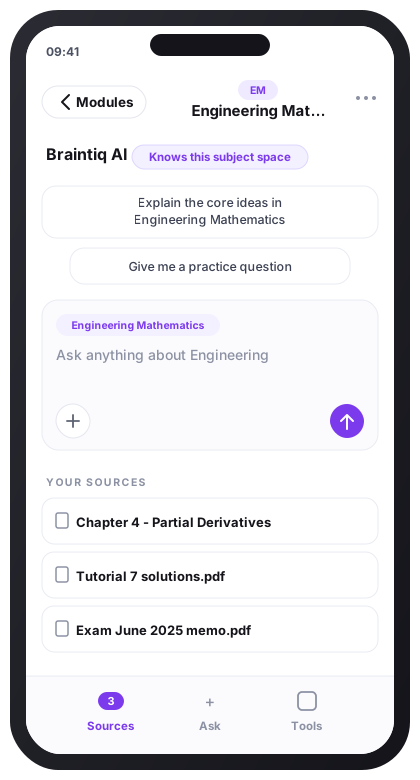
Every claim it makes is traced back to the document and page it came from, and anything that could not be traced is marked rather than quietly included. That matters for spaced repetition specifically, because the whole method depends on drilling correct material. A wrong fact reviewed five times at expanding intervals is a wrong fact you will now remember for years.
You can use it without an account at braintiq.app/try.
The short version
- Spread practice out. Identical total time, substantially better retention.
- The difficulty you feel during a spaced review is the mechanism, not a failure.
- Retrieve, do not re-read. Struggling to produce an answer is what strengthens it.
- One day, three days, one week, two weeks, one month. Shorten on failure, stretch on ease.
- A review is ten minutes and it is a test, not a reading.
- Flashcards for atomic facts. Problems for procedures.
- Mix topics in a session. Choosing the method is a separate skill from using it.
- Understand first. Drilling something you never understood produces words, not knowledge.