N2 Engineering Mathematics: Exponents and Logarithms, Worked Properly
by Braintiq Academic Team
If you are writing N2 Engineering Mathematics, the exponents and logarithms question is one you can turn into a guaranteed block of marks. It is short, it is predictable, and unlike the trigonometry or the graph work, it does not really have a bad day. Either you know the seven laws and can apply them in order, or you do not.
Almost nothing useful has been written about this paper online. Search for help with N2 maths and you get either the full NATED syllabus as a PDF, or a video someone recorded off a whiteboard in 2015. So this is the topic worked out properly, in the order the paper asks for it, with the four mistakes that cost the most marks called out where they actually happen.
What the paper actually asks
The N2 Engineering Mathematics paper is written to the NATED Report 191 syllabus. Exponents and logarithms usually appear as one full question, and the structure is stable year to year:
- Simplify an expression using the laws of exponents, leaving the answer with positive exponents.
- Solve an exponential equation, usually by making the bases the same.
- Apply the definition of a logarithm, or convert between logarithmic and exponential form.
- Use the laws of logarithms to simplify or solve.
That is worth around 20 marks on a 100 mark paper. It is the highest ratio of marks to study time anywhere in the syllabus, because the rules are finite. There are seven exponent laws and three logarithm laws, and that is the entire toolkit.
The seven laws, and what each one is for
Write these out until you can do it from memory. Not because memorising is the point, but because you cannot spot which one applies if you are reconstructing them under exam pressure.
Multiplication. When the bases match and you are multiplying, add the exponents.
$$a^m \times a^n = a^{m+n}$$
Division. When the bases match and you are dividing, subtract.
$$\frac{a^m}{a^n} = a^{m-n}$$
Power of a power. Multiply the exponents.
$$(a^m)^n = a^{mn}$$
Power of a product. The exponent goes to every factor inside.
$$(ab)^n = a^n b^n$$
Power of a quotient. Same idea, top and bottom.
$$\left(\frac{a}{b}\right)^n = \frac{a^n}{b^n}$$
Zero exponent. Anything except zero itself, raised to zero, is one.
$$a^0 = 1, \quad a \neq 0$$
Negative exponent. A negative exponent means reciprocal. It does not mean a negative answer, and this is where the marks go.
$$a^{-n} = \frac{1}{a^n}$$
Mistake one: treating a negative exponent as a negative number
This is the single most common error in the whole topic, and it is worth being blunt about it.
$$2^{-3} \neq -8$$
$$2^{-3} = \frac{1}{2^3} = \frac{1}{8}$$
A negative exponent is an instruction to flip, not an instruction to change sign. Every time you see one, say "flip it" in your head before you write anything down.
The version of this that costs the most marks looks like this:
$$\frac{1}{x^{-2}}$$
The exponent is negative and it is already on the bottom. Flipping it sends it up:
$$\frac{1}{x^{-2}} = x^{2}$$
Students who have half-learned the rule write $\frac{1}{x^2}$ here and lose the mark. The rule is not "negative exponents go to the bottom". It is "negative exponents move to the other side of the fraction line and become positive".
A worked simplification
Simplify, leaving your answer with positive exponents only:
$$\frac{6a^{3}b^{-2}}{9a^{-1}b^{4}}$$
Step 1. Handle the numbers separately from the letters. The coefficients are 6 and 9, which simplify to $\frac{2}{3}$. Do this first so it does not clutter the exponent work.
Step 2. Apply the division law to each letter in turn. For $a$: the exponents are 3 on top and $-1$ on the bottom, so subtract.
$$a^{3 - (-1)} = a^{4}$$
Note the double negative. Subtracting a negative exponent adds. This is mistake two, and it appears in almost every paper.
For $b$: the exponents are $-2$ on top and 4 on the bottom.
$$b^{-2 - 4} = b^{-6}$$
Step 3. Clear the negative exponent. The question said positive exponents only, so $b^{-6}$ moves to the denominator.
$$\frac{2a^{4}}{3b^{6}}$$
That is the answer. Notice that the last step exists only because the question asked for it. If a question does not say "with positive exponents", leaving a negative exponent is not wrong, but write it in positive form anyway. It costs nothing and memos are written that way.
Solving exponential equations
The whole technique is one sentence: make the bases the same, then equate the exponents.
Solve for $x$:
$$2^{x+1} = 32$$
The left side is base 2. So write the right side as a power of 2. Since $32 = 2^5$:
$$2^{x+1} = 2^{5}$$
Bases match, so the exponents must be equal:
$$x + 1 = 5$$
$$x = 4$$
A harder version, which is the one that actually appears:
$$9^{x} = 27$$
The bases are different, but both are powers of 3. Rewrite both:
$$(3^{2})^{x} = 3^{3}$$
$$3^{2x} = 3^{3}$$
$$2x = 3$$
$$x = \frac{3}{2}$$
Mistake three is stopping at $3^{2x} = 3^3$ and writing $x = 3$, because the eye sees the 3 on the right and matches it to the $x$. The exponent on the left is $2x$, not $x$. Write the exponent equation on its own line before solving it. That one habit removes this error entirely.
Logarithms are exponents in different clothing
A logarithm answers the question "what exponent do I need?" The definition is the only thing you must hold onto:
$$\log_{a} b = c \quad \text{means} \quad a^{c} = b$$
Read it out loud as: log base $a$ of $b$ is the exponent you put on $a$ to get $b$.
So $\log_{2} 8 = 3$, because $2^3 = 8$. And $\log_{10} 1000 = 3$, because $10^3 = 1000$.
If you can convert fluently between the two forms, most log questions on this paper collapse into arithmetic you can already do.
Convert to exponential form and solve:
$$\log_{4} x = 3$$
By the definition, base 4, exponent 3:
$$4^{3} = x$$
$$x = 64$$
The three logarithm laws
They are the exponent laws again, one level down.
Product. A log of a product is a sum of logs.
$$\log_a (mn) = \log_a m + \log_a n$$
Quotient. A log of a quotient is a difference.
$$\log_a \left(\frac{m}{n}\right) = \log_a m - \log_a n$$
Power. An exponent inside a log comes out to the front.
$$\log_a (m^{p}) = p \log_a m$$
Mistake four is inventing a fourth law that does not exist. There is no rule for $\log_a(m + n)$. A log of a sum does not break apart. If you find yourself writing $\log(x + y) = \log x + \log y$, stop, because that statement is false and the memo will treat it as such.
Test it with numbers if you ever doubt it. $\log_{10}(10 + 90) = \log_{10} 100 = 2$. But $\log_{10} 10 + \log_{10} 90 = 1 + 1.954 = 2.954$. Different answers, so the rule is not real.
A worked logarithm question
Simplify without a calculator:
$$\log_{2} 16 + \log_{2} 4$$
Two routes work. By the product law, combine first:
$$\log_{2}(16 \times 4) = \log_{2} 64 = 6$$
because $2^6 = 64$. Or evaluate each separately: $\log_2 16 = 4$ and $\log_2 4 = 2$, giving $4 + 2 = 6$. Same answer, and in the exam take whichever you can see faster. If the numbers are friendly, evaluate separately. If they are not, combine first.
How to practise this so it sticks
Doing twenty simplifications in one sitting feels productive and mostly is not. What it trains is your ability to do simplifications while already warmed up, which is not the condition you will be in at the start of an exam.
Better: do four questions today, four in two days, four next week, from the same topic. You will get some wrong on the second sitting that you got right on the first, and that is the point. The forgetting is where the learning happens, and the research on spaced practice is unusually consistent about this.
The other habit worth building is working from past papers rather than textbook exercises. Textbook questions are written to teach a rule one at a time. Exam questions are written to test whether you can pick the right rule without being told which chapter you are in. Those are different skills and only one of them is examined.
Where Braintiq fits
I built Braintiq because I am doing this coursework myself and I wanted a study tool that worked from my actual documents rather than from the internet's general idea of what N2 maths is.
You upload your lecture notes, your tutorials and your past paper memos into a subject space. When you ask for a study pack or a set of flashcards, it is built from those documents, and every claim it makes is traced back to the page it came from.
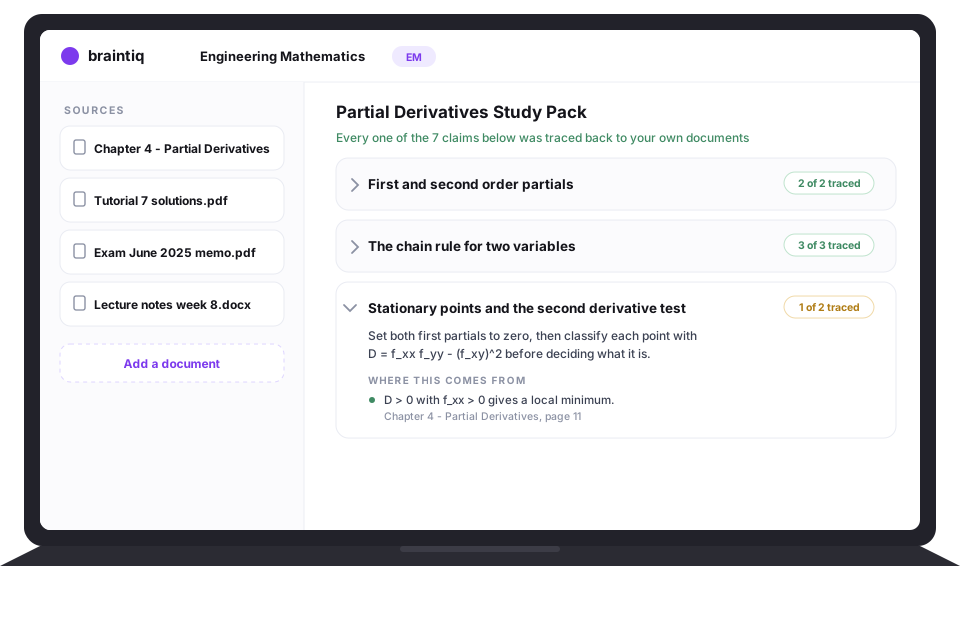
The counts in that screenshot are the part I care about most. When a section says "1 of 2 traced", it means one sentence in that section could not be matched to anything in the uploaded documents, and it is marked rather than hidden. A study guide that looks clean but contains an invention is worse than no study guide, because you will revise the invention with the same confidence as the rest.
On a phone the same space is three screens: your sources, the assistant, and the tools that build things from them.

You can try it without an account at braintiq.app/try.
The short version
- A negative exponent means reciprocal, never a negative answer.
- Subtracting a negative exponent adds. Write the subtraction out.
- To solve an exponential equation, make the bases match, then write the exponent equation on its own line before solving it.
- A logarithm is an exponent. Convert to exponential form whenever you are stuck.
- There is no law for the log of a sum. If you write one, you have invented it.
Get those five right and the exponents and logarithms question stops being something you hope goes well.