Active Recall: Why Re-Reading Your Notes Does Almost Nothing
by Braintiq Academic Team
Ask a hall of students how they revise and most will say they read through their notes. Some will highlight. Some will rewrite notes more neatly.
These are the three most popular revision methods and they sit near the bottom of every ranking researchers have produced. That is not a small gap in effectiveness. In controlled comparisons, students who re-read perform substantially worse on delayed tests than students who spent the same time testing themselves.
Understanding why is what makes the alternative stick, so it is worth a minute.
Fluency is not knowledge
When you read a page for the second time, it feels easy. The sentences are familiar, nothing surprises you, and the whole thing goes down smoothly.
Your brain reads that smoothness as evidence that you know the material. It is not. It is evidence that you recognise the material, which is a much weaker thing.
Recognition is being able to say "yes, that is right" when the answer is in front of you. Recall is producing the answer when it is not. An exam asks for recall. Re-reading practises recognition, then reports back that you are ready, and the first time you discover the difference is in the exam hall.
Researchers call this the fluency illusion, and it is the central problem with passive revision. The method feels most effective precisely when it is doing least.
What retrieval does instead
Active recall means trying to produce the answer from memory before looking at it.
When you retrieve something successfully, the act of retrieval strengthens the memory more than re-reading it would have. When you fail to retrieve it, you have found a real gap, which is information you did not have a minute earlier.
Both outcomes are useful. That is the property re-reading lacks: reading a page cannot tell you whether you would have been able to produce it.
The effect is large and it has been replicated for decades under the name the testing effect. Testing yourself is not just assessment. It is one of the most effective ways to learn in the first place.
Six ways to do it
The blank page. Put the topic at the top of an empty sheet and write everything you can remember. Then open your notes and add what you missed in a different colour. Over several sessions the coloured additions show you exactly which gaps keep returning, which is more useful than any feeling about which topics are weak.
Cover the worked solution. For anything with a method, attempt it before reading the answer. Uncover one line when stuck, cover it again, continue. Reading a worked solution start to finish produces a strong feeling of understanding and almost no ability to reproduce it.
Explain it out loud. To a friend, to an empty room, to a recording. The moment you cannot finish a sentence is the moment you have found something you do not actually know. This is uncomfortable and unusually efficient.
Questions in the margin. As you take notes in class, write a question in the margin next to each section rather than a heading. Later, cover the notes and answer the questions. This turns your notes into a test with no extra work.
Past papers with no notes, timed. The highest-fidelity retrieval practice available, because it matches the conditions of the real assessment. Do these earlier than feels comfortable. Most students save past papers for the final week, which wastes their diagnostic value.
Flashcards, for the right things. Good for atomic facts with clean boundaries: definitions, formulas, the reasons list in Euclidean geometry, functional groups. Bad for procedures, because you cannot honestly self-mark a process and will award yourself the mark for recognising its shape.
Make it harder on purpose
A few adjustments that feel worse and work better.
Do not look at the answer too quickly. Sit with the difficulty for ten or twenty seconds. The struggle is doing the work, and cutting it short to check removes the benefit.
Space it out. Retrieval works best when the material has partly faded. Testing yourself immediately after reading is nearly as weak as re-reading, because nothing has been forgotten yet and there is nothing to reconstruct.
Mix the topics. Doing twenty questions on one topic means you never practise deciding which method a question needs, because the block already told you. Mixing feels worse and trains the selection skill the exam actually tests.
Mark yourself strictly. Award the mark only for what the memo would award. Being generous with yourself converts a diagnostic into reassurance, and reassurance is not what you needed.
What re-reading is still good for
It is not useless, it is misapplied.
Re-reading is reasonable on a first pass through unfamiliar material, when you are building understanding rather than consolidating it. You cannot retrieve something you have never encountered.
The error is continuing to re-read once you understand it. At that point the activity should change from input to retrieval, and most students never make the switch, because the first method still feels fine.
The sequence that works: read to understand, then retrieve to remember, spaced out over time.
A weekly shape
For a subject with three lectures a week, something like this is enough and takes under an hour:
- After each lecture, write five margin questions on that lecture's notes. Five minutes.
- The next day, answer them from memory. Ten minutes.
- At the weekend, blank page recall for the week's topics. Twenty minutes.
- Once a fortnight, a past paper question on older material, timed and strictly marked.
Nothing there takes long. The value is in the frequency and in the fact that every item is retrieval rather than reading.
The uncomfortable part
Active recall feels worse than re-reading. You will feel less confident afterwards, not more, because you have just produced direct evidence of what you cannot yet do.
That feeling is the method working. Re-reading feels good because it hides the same gaps.
If you take one thing from this: judge a study session by what you could produce without looking, not by how much you covered.
Doing it with your own material
The retrieval practice that matters most is on your own course material, because that is what tells you what your lecturer examines rather than what the subject contains in general.
Braintiq is built that way. You upload your notes, tutorials and past papers into a subject space, and the questions, flashcards and study packs it produces are built from those pages.
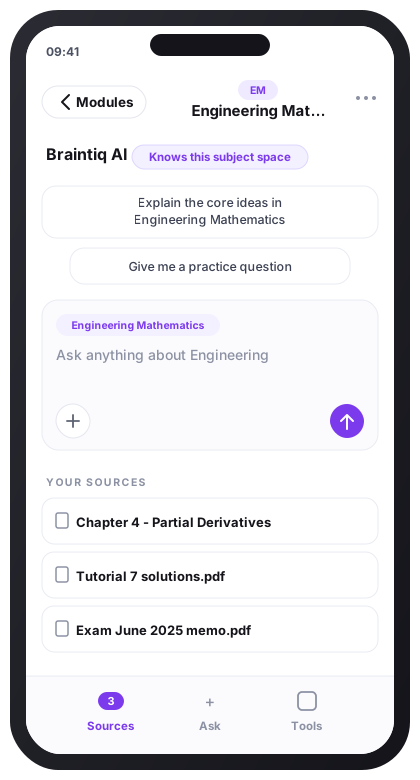
Every claim it makes is traced back to the document and page it came from, and anything it could not trace is marked rather than quietly included. That matters for retrieval practice specifically: the whole method depends on drilling correct material, and a wrong fact retrieved repeatedly is a wrong fact you have now learned properly.
You can use it without an account at braintiq.app/try.
The short version
- Re-reading builds recognition. Exams ask for recall. They are not the same thing.
- Smoothness while revising is the fluency illusion, not evidence of knowing.
- Try to produce the answer before looking. Success strengthens, failure locates a gap.
- Blank page, covered solutions, explaining out loud, margin questions, timed past papers.
- Sit with the difficulty before checking.
- Space it out, mix the topics, and mark yourself strictly.
- Re-read on a first pass only, then switch to retrieval and never switch back.
- Judge a session by what you could produce without looking.