NSC Mathematics Paper 2: Geometry, Trigonometry and the Marks Most People Leave
by Braintiq Academic Team
Paper 2 has a reputation. Ask a matric class which paper worries them and most will say this one, usually because of Euclidean geometry, and usually because somebody told them geometry is about being clever.
It is not. Euclidean geometry is the most learnable section in the entire subject, because the set of acceptable reasons is a closed, published list. There are perhaps fifteen of them. The memo wants them by name, and once you can name them, the proofs write themselves.
This is what Paper 2 is made of and where the marks go.
The shape of the paper
Paper 2 is 150 marks in three hours, and it covers statistics, analytical geometry, trigonometry and Euclidean geometry. The approximate allocation:
- Statistics and regression: about 20 marks
- Analytical geometry: about 40 marks
- Trigonometry: about 50 marks
- Euclidean geometry: about 40 marks
Trigonometry is the biggest block and it is also the most mechanical, which is a useful combination. Statistics is the smallest and the most reliably scored, and students who are short on time should never be the ones skipping it.
Statistics: the marks are in reading, not calculating
Almost everything in this section is done on your calculator. The marks are for knowing which button and for interpreting what comes out.
Two things get examined every year.
The ogive, or cumulative frequency curve. You are asked to draw one, or read quartiles off one. The single rule that matters: plot cumulative frequency against the upper boundary of each class interval. Plotting against the midpoint is the most common error in the section and it moves every point on your curve.
To read the median off an ogive, go to half the total frequency on the vertical axis, across to the curve, then down. The quartiles are at a quarter and three quarters of the total. Draw those lines on the diagram in pencil, because the marker is looking for evidence you used the graph rather than guessed.
The regression question. You are given paired data, asked for the equation of the least squares regression line, the correlation coefficient $r$, and then asked to interpret it.
The calculation is calculator work. The interpretation is where marks are lost, and there are only two things to say:
- The sign of $r$ says whether the relationship is positive or negative.
- The magnitude says how strong it is. Close to 1 or $-1$ is strong, close to 0 is weak.
If $r = -0.89$, the answer is "a strong negative relationship". Not "a bad relationship". Not "no relationship because it is negative". A negative correlation is a real relationship, it just runs the other way.
The trap question asks you to predict a value far outside the given data range and then asks whether the prediction is reliable. The answer is no, because you are extrapolating beyond the data the line was fitted to, and there is no evidence the pattern continues. That is 2 marks for one sentence you can prepare in advance.
Analytical geometry: write the formula down first
This section is coordinate geometry, and it rewards mechanical discipline more than insight. The formulas are on the data sheet, which means the examiner is not testing recall. They are testing whether you can pick the right one and substitute carefully.
$$\text{distance} = \sqrt{(x_2 - x_1)^2 + (y_2 - y_1)^2}$$
$$\text{midpoint} = \left(\frac{x_1 + x_2}{2}, \frac{y_1 + y_2}{2}\right)$$
$$\text{gradient} = \frac{y_2 - y_1}{x_2 - x_1}$$
Three relationships come up constantly:
- Parallel lines have equal gradients.
- Perpendicular lines have gradients whose product is $-1$, so $m_1 \times m_2 = -1$.
- Collinear points lie on one line, which you show by proving two gradients between them are equal.
The inclination question asks for the angle a line makes with the positive $x$ axis, and the relationship is $m = \tan\theta$. If the gradient is negative, your calculator gives a negative angle, and the answer the memo wants is the obtuse one. Add 180 degrees. This single step is worth a mark on most papers and is skipped constantly.
For a circle, the equation is
$$(x - a)^2 + (y - b)^2 = r^2$$
with centre $(a, b)$. Note the signs: a circle centred at $(3, -2)$ has equation $(x - 3)^2 + (y + 2)^2 = r^2$. If a question gives you the expanded form, you complete the square to get back to this one, and completing the square is examinable in its own right.
The tangent-to-a-circle question is the standard hard one, and it is always the same three steps. Find the gradient of the radius to the point of contact. The tangent is perpendicular to that radius, so take the negative reciprocal. Use the point and that gradient in $y - y_1 = m(x - x_1)$.
Trigonometry: identities are for simplifying, equations are for solving
Fifty marks, and they split cleanly into two kinds of question.
Identities. You are given an expression and asked to prove it equals something else. The method is always the same: start with the more complicated side and work towards the simpler one. Never work on both sides at once, because that is not a proof and memos mark it as such.
The identities you must know cold:
$$\sin^2\theta + \cos^2\theta = 1$$
$$\tan\theta = \frac{\sin\theta}{\cos\theta}$$
Everything else on the data sheet is derived. When you are stuck on an identity, the move that works more often than any other is to write everything in terms of sine and cosine and then simplify.
Equations. You are asked to solve for $\theta$, usually in a stated interval. The structure is: get to a single trig ratio equal to a number, find the reference angle, then write the general solution.
For $\sin\theta = k$, the solutions are $\theta = \text{ref} + 360°n$ and $\theta = 180° - \text{ref} + 360°n$.
For $\cos\theta = k$, they are $\theta = \pm\text{ref} + 360°n$.
For $\tan\theta = k$, they are $\theta = \text{ref} + 180°n$, and note the 180 rather than 360, because tan repeats twice as often.
The marks lost here are almost always the second solution. A student finds the reference angle, writes one answer, and stops. Sine and cosine equations have two families of solution in every revolution. Write both, every time, then apply the interval.
For the 2D and 3D problems with the sine and cosine rules, the rule for choosing is simple. Use the sine rule when you have a matched pair, meaning a side and the angle opposite it. Use the cosine rule when you do not, which in practice means when you have three sides, or two sides and the angle between them.
Euclidean geometry: the reasons are the answer
Here is the thing nobody says clearly enough. In a geometry proof, the statement earns you very little. The reason is what the memo pays for.
Writing "$\hat{A} = \hat{B}$" earns nothing on its own. Writing "$\hat{A} = \hat{B}$, angles in the same segment" earns the mark. Every line of a proof is a statement and a reason, and you write both, every time, even when the reason feels obvious.
The list of acceptable reasons is closed and published in the examination guidelines. Learn them as phrases, because the phrase is what you write. The ones that appear most:
- angles in the same segment
- angle at centre equals twice angle at circumference
- angle in a semicircle
- opposite angles of a cyclic quadrilateral are supplementary
- exterior angle of a cyclic quadrilateral equals the interior opposite angle
- tangent perpendicular to radius
- tan-chord angle, also called the angle between a tangent and a chord
- line from centre perpendicular to a chord bisects the chord
To prove a quadrilateral is cyclic, there are exactly three routes and you should know which you are using: opposite angles supplementary, exterior angle equals interior opposite, or two angles subtended by the same line segment on the same side are equal.
For the proportionality and similarity work, similar triangles need equal angles, and then corresponding sides are in proportion. The most common error is writing the proportion with the sides in the wrong correspondence. Name the triangles in matching vertex order, so triangle $ABC$ similar to triangle $DEF$ means $A$ corresponds to $D$, $B$ to $E$, $C$ to $F$, and the ratios follow from the naming.
How to practise geometry specifically
Do not read proofs. Reading a completed proof produces a strong feeling of understanding and almost no ability to produce one.
Instead: cover the proof, look only at the diagram and what is given, and try to write it. When you get stuck, uncover one line, then cover it again and continue. What you are training is the search, not the recall, and the search is what the exam tests.
Second habit: on every diagram, mark what you know directly on the figure before writing anything. Equal sides, right angles, the centre, the tangent points. Half the difficulty in geometry is holding the configuration in your head, and marking the diagram takes it out of your head and puts it on the page.
Working from your own past papers
The most reliable revision for Paper 2 is past papers marked honestly against the official memo. That is where you discover that you have been writing correct statements with no reasons, which is a habit that costs several marks per proof and takes one evening to fix.
Braintiq is built around using your own material. You upload your past papers, memos and class notes into a subject space, and what it builds comes from those pages rather than from a general model of the subject.
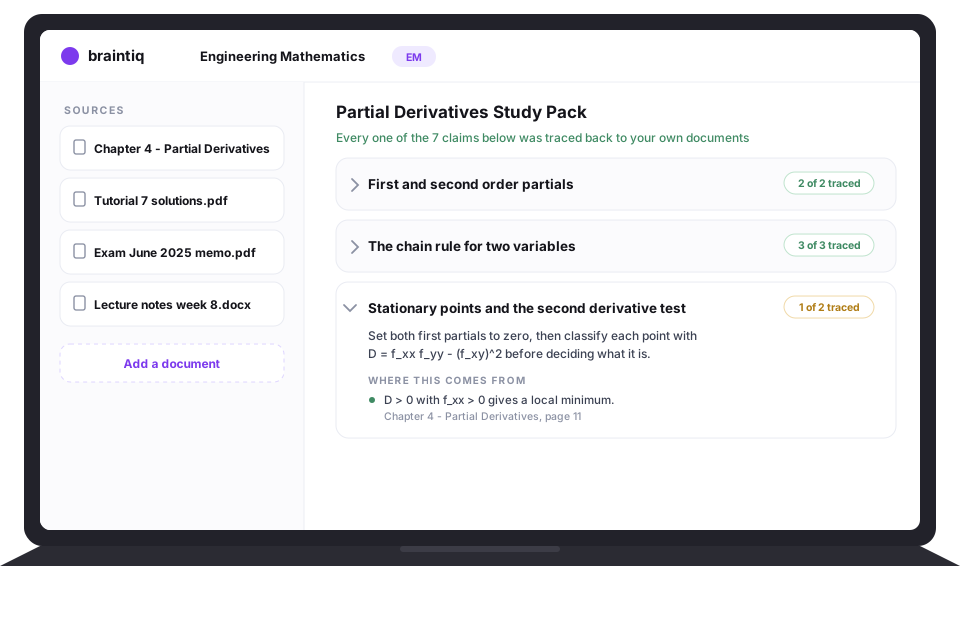
Every claim in a generated study pack carries the document and page it came from, and anything that could not be traced is marked rather than hidden. For geometry that matters more than usual, because a proof with a plausible but wrong reason looks exactly like a correct one until a marker reads it.
You can use it without an account at braintiq.app/try.
The short version
- Plot an ogive against the upper class boundary, never the midpoint.
- The sign of $r$ is the direction, the size is the strength, and extrapolation is unreliable because it leaves the data.
- Perpendicular means $m_1 m_2 = -1$. A negative gradient needs 180 added to the inclination.
- Prove an identity from one side only, and when stuck, write everything as sine and cosine.
- Sine and cosine equations have two solution families per revolution. Write both.
- Sine rule when you have a matched pair, cosine rule when you do not.
- In geometry the reason is the mark. Statement and reason, every line.
- Mark the diagram before you write anything.