NSC Physical Sciences Paper 2: The Mole Is the Whole Paper
by Braintiq Academic Team
Physical Sciences Paper 2 is the chemistry paper: organic chemistry, rates and equilibrium, acids and bases, electrochemistry, and the fertiliser industry. It looks like five separate topics.
It is not. Four of those five run their calculations through the mole, and once you see that, the paper stops being five things to learn and becomes one thing to master plus some context.
This is the paper reorganised around that.
The mole, and why everything goes through it
A mole is a counting unit, like a dozen. One mole is $6.02 \times 10^{23}$ particles. That number is Avogadro's constant and it is on your data sheet.
Chemistry needs it because you cannot count atoms but you can weigh them. The mole is the bridge between the world you can measure, which is grams and litres, and the world the equation describes, which is particles.
Three relationships carry almost every calculation in the paper:
$$n = \frac{m}{M}$$
moles from mass, where $M$ is the molar mass in grams per mole.
$$n = cV$$
moles from a solution, where $c$ is concentration in moles per cubic decimetre and $V$ is volume in cubic decimetres.
$$n = \frac{V}{V_m}$$
moles of a gas at STP, where $V_m$ is 22.4 cubic decimetres per mole.
Every stoichiometry question is the same shape. Convert what you are given into moles. Use the balanced equation to get moles of what you want. Convert back into whatever unit the question asked for.
Say that to yourself before starting any calculation: into moles, across the equation, back out. Students who lose marks here almost always lost them by trying to go directly from grams to grams, which the equation does not let you do, because the coefficients count particles and not mass.
The ratio step is where the marks are
The balanced equation gives you the ratio. That is its job.
For
$$2H_2 + O_2 \rightarrow 2H_2O$$
two moles of hydrogen react with one mole of oxygen. If you have 0.4 moles of hydrogen, you need 0.2 moles of oxygen, and you will make 0.4 moles of water.
Write the ratio down explicitly as a line of working. Something like "2 mol H2 : 1 mol O2, so $n(O_2) = 0.4 \div 2 = 0.2$". The memo pays for that line, and students who do it in their heads lose it even when the final answer is right.
The limiting reagent question is the version that separates grades. You are given amounts of both reactants and asked how much product forms. The method:
- Convert both reactants to moles.
- Divide each by its coefficient in the balanced equation.
- The smaller answer is the limiting reagent. That is the one that runs out.
- Do the rest of the calculation from the limiting reagent only, and ignore the other.
Step 2 is the one people skip. You cannot just compare moles, because the coefficients differ. Dividing by the coefficient is what makes the comparison fair.
Organic chemistry: naming is a procedure
Organic chemistry feels like memorisation and is mostly a procedure. Naming a compound is four steps in a fixed order:
- Find the longest continuous carbon chain. That gives the stem: meth, eth, prop, but, pent, hex.
- Identify the functional group. That gives the ending and it takes priority in numbering.
- Number the chain from the end that gives the functional group the lowest number.
- Name and number the branches alphabetically, in front.
The functional groups examined are alkanes, alkenes, alkynes, haloalkanes, alcohols, aldehydes, ketones, carboxylic acids and esters. Know the structure and the ending for each, and know which reactions convert which into which.
The physical properties question is reliably worth marks and reliably answered badly. When asked why one compound has a higher boiling point than another, the answer has two parts and both are needed:
- Name the intermolecular force. Hydrogen bonding, dipole-dipole, or London forces.
- Say that stronger forces need more energy to overcome, so the boiling point is higher.
For compounds with the same functional group, the longer chain has the higher boiling point, because a bigger molecule has more surface contact and therefore stronger London forces. Say "more energy required to overcome" explicitly. That phrase is usually a mark by itself.
Rates and equilibrium
For rate, the examinable idea is collision theory. A reaction goes faster when particles collide more often, or collide harder. Every factor works through one of those two:
- Higher concentration or pressure: more particles in the same space, so more frequent collisions.
- Higher temperature: particles move faster, so collisions are both more frequent and more energetic, and more of them exceed the activation energy.
- Smaller particle size: more surface area exposed, so more frequent collisions.
- A catalyst: provides an alternative pathway with lower activation energy.
Note what a catalyst does not do. It does not change the position of equilibrium and it does not change the yield. It gets you to the same place sooner. That distinction is examined almost every year.
For equilibrium, the whole section is Le Chatelier's principle: if you disturb a system at equilibrium, it shifts to oppose the change.
Apply it mechanically. Increase the concentration of a reactant, and the system shifts right to use it up. Increase pressure, and it shifts towards whichever side has fewer moles of gas. Increase temperature, and it shifts in the endothermic direction, because that absorbs the added heat.
That last one needs you to read whether the forward reaction is exothermic or endothermic from the sign of $\Delta H$, and it is the most common place to go wrong. A negative $\Delta H$ means the forward reaction releases heat, so heating shifts it backwards.
Acids and bases
The titration calculation is the single most predictable calculation on the paper, and it is the mole method again with a specific formula:
$$\frac{c_a V_a}{c_b V_b} = \frac{n_a}{n_b}$$
where $n_a$ and $n_b$ are the coefficients from the balanced equation. Everything else is substitution. Volumes must be in the same unit on both sides, and the classic error is mixing millilitres and cubic decimetres.
Definitions get asked directly and are worth free marks if you have them word-perfect. An acid is a proton donor and a base is a proton acceptor, which is the Bronsted-Lowry definition. A conjugate base is what remains after an acid has donated its proton. An ampholyte can act as either, and water is the standard example.
For pH:
$$\text{pH} = -\log[H_3O^+]$$
A strong acid ionises completely, so the concentration of hydronium equals the concentration of the acid. A weak acid does not, which is why a weak acid of the same concentration has a higher pH.
Electrochemistry
Two cells, and the difference between them is the thing being tested.
A galvanic cell is spontaneous and produces electricity. A chemical reaction drives a current.
An electrolytic cell is not spontaneous and consumes electricity. A current drives a chemical reaction.
In both, the definitions of the electrodes are identical and worth learning as a pair: oxidation happens at the anode, reduction at the cathode. That is true in both cell types, always. What changes is the sign of the electrodes, not what happens at them.
Oxidation is the loss of electrons, reduction is the gain. The memory aid that survives pressure is OIL RIG: oxidation is loss, reduction is gain.
To find the cell potential:
$$E_{cell} = E_{cathode} - E_{anode}$$
using the table of standard reduction potentials on the data sheet. A positive answer means the reaction is spontaneous, which means it is a galvanic cell.
How to prepare for this paper
Work past papers, and mark yourself against the official memo rather than your own impression. In chemistry the memo is unusually specific about wording, particularly for the explanation questions, and you will find you have been giving the right idea in the wrong words.
Build a single page of definitions and learn it properly: acid, base, conjugate pair, ampholyte, oxidation, reduction, anode, cathode, activation energy, catalyst. Those are directly examined, they are worth several marks in total, and they cost one evening.
Braintiq works from your own material. You upload your past papers, memos and class notes into a subject space, and what it builds comes from those pages rather than from a general idea of the syllabus.
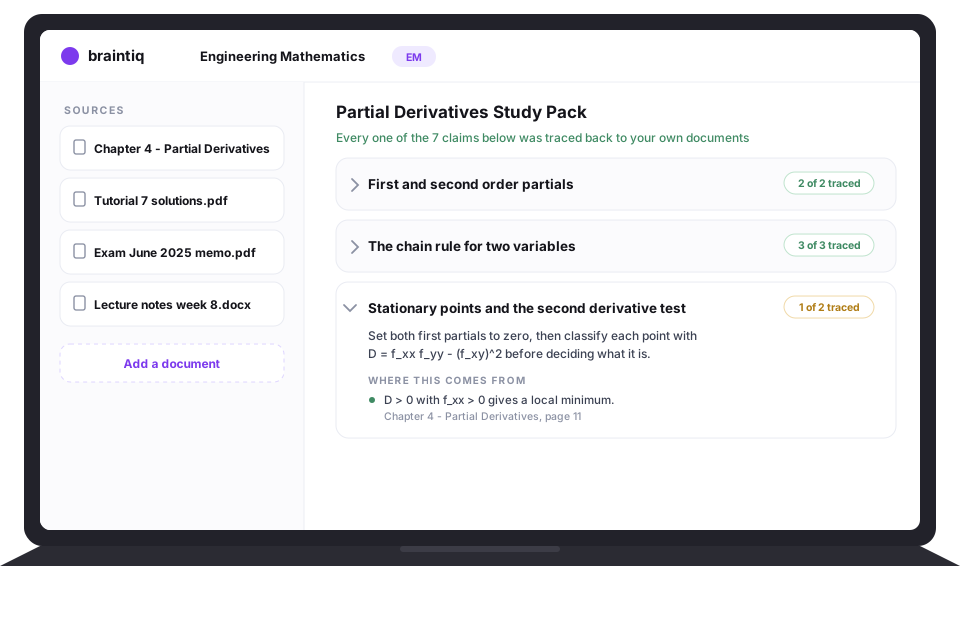
Each section of a generated study pack reports how many of its claims could be traced to a page in your documents, and anything that could not is marked rather than left in quietly. In chemistry that matters, because a confidently worded wrong statement about what a catalyst does to yield is exactly the kind of thing that survives revision.
You can use it without an account at braintiq.app/try.
The short version
- Into moles, across the balanced equation, back out. Never grams straight to grams.
- Write the ratio line explicitly. It is a mark.
- For limiting reagent, divide moles by the coefficient before comparing.
- Boiling point answers need the force named AND the energy sentence.
- A catalyst changes the rate, never the yield or the equilibrium position.
- Heating shifts equilibrium in the endothermic direction. Check the sign of $\Delta H$ first.
- Oxidation at the anode, reduction at the cathode, in both cell types.
- Learn the definitions word-perfect. They are the cheapest marks on the paper.