NSC Physical Sciences Paper 1: The Questions That Repeat Every Year
by Braintiq Academic Team
Physical Sciences Paper 1 is the physics paper: mechanics, waves and sound, electricity and magnetism, electrodynamics, and the photoelectric effect. It is 150 marks in three hours, and it is the NSC paper where recognising the question type matters most.
That is not a criticism of the paper. It is a consequence of physics being built on a small number of laws applied to a large number of situations. Once you can name what a question is, the first two lines of your answer are determined, and those first two lines are usually worth half the marks.
Here are the six that come back every year, and what to write first for each.
One: the vertical projectile motion graph question
You are given a graph of velocity against time for an object thrown upward, or asked to draw one. Sometimes it is position against time, or acceleration against time, and sometimes it is a ball bouncing.
The opening move is to write down the sign convention. Choose upward as positive, and say so on the page. Almost every mark lost here is a sign error that traces back to never having decided.
Then the facts that do not change:
- Acceleration is $9.8$ metres per second squared downward, always, including at the highest point. The object is momentarily at rest at the top, but it is not in equilibrium, and the acceleration does not become zero. This is the most commonly examined misconception in the entire paper.
- On a velocity-time graph, the gradient is acceleration and the area under the curve is displacement.
- For a ball bouncing, the velocity reverses sign instantly at the bounce, which makes a vertical jump on the graph.
The equations of motion, all four of which are on the data sheet:
$$v_f = v_i + a\Delta t$$
$$\Delta x = v_i \Delta t + \tfrac{1}{2} a \Delta t^{2}$$
$$v_f^{2} = v_i^{2} + 2a\Delta x$$
$$\Delta x = \frac{v_i + v_f}{2} \Delta t$$
Choosing between them is a matter of listing what you have and what you want. Write the list. If you have $v_i$, $a$ and $\Delta x$, and you want $v_f$, only the third equation has those four and nothing else.
Two: Newton's laws with a system of two bodies
Two blocks connected by a string, or a block on a table pulled by a hanging mass, or a car towing a trailer.
The opening move is a free-body diagram for each body separately. Not one diagram for the system. One per body.
Then apply $F_{net} = ma$ to each body, giving you two equations. The tension appears in both, with opposite signs, which is what lets you solve them together.
The mark that gets left behind most often is stating Newton's third law properly. If a question asks about the force the trailer exerts on the car, the answer is that it is equal in magnitude and opposite in direction to the force the car exerts on the trailer, and those two forces act on different bodies. That last clause is the mark. An action-reaction pair never acts on the same object, which is why they never cancel.
Three: momentum and impulse
A collision, or an explosion, or something changing velocity over a stated time.
The opening move is to state that momentum is conserved, and to say why: the system is isolated, meaning no net external force acts on it.
$$p = mv$$
$$\sum p_{\text{before}} = \sum p_{\text{after}}$$
Momentum is a vector, so direction matters and you must choose a positive direction before substituting. A 2 kg trolley moving left at 3 metres per second has momentum of $-6$ kilogram metres per second if you chose right as positive, and writing $+6$ is the error that ends the question.
For impulse:
$$F_{net}\Delta t = \Delta p = m v_f - m v_i$$
The classic application question is why airbags and crumple zones reduce injury. The answer is not "they absorb the force". The change in momentum is fixed by the crash, so if $\Delta t$ is made larger, $F_{net}$ must be smaller. Say it in those terms and the marks are yours.
Four: work, energy and power
A body moving along a surface with friction, up an incline, or a machine doing work at a rate.
The opening move is to decide whether the question wants the work-energy theorem or conservation of mechanical energy, because they are not interchangeable.
Use conservation of mechanical energy only when no friction acts. Then:
$$E_{p} + E_{k} \text{ at the start} = E_{p} + E_{k} \text{ at the end}$$
Use the work-energy theorem when friction is present, which is most of the time:
$$W_{net} = \Delta E_{k} = \tfrac{1}{2}mv_f^{2} - \tfrac{1}{2}mv_i^{2}$$
The recurring trap is the sign of the work done by friction. Friction always opposes motion, so the work it does is always negative. If you have written a positive number for friction's work, you have made a sign error, without exception.
Power is the rate of doing work:
$$P = \frac{W}{\Delta t} \qquad \text{and for constant velocity} \qquad P = Fv$$
Five: electric circuits
A circuit with resistors in series and parallel, usually with an internal resistance in the battery, and usually asking what happens to some reading when a switch is opened or closed.
The opening move is to redraw the circuit. Redraw it, simplified, with the parallel combination replaced by its equivalent. Almost nobody does this and almost everybody who does gets the question right.
$$\text{Series: } R_s = R_1 + R_2 + \dots$$
$$\text{Parallel: } \frac{1}{R_p} = \frac{1}{R_1} + \frac{1}{R_2} + \dots$$
$$\text{emf: } \varepsilon = I(R + r)$$
For the "what happens when the switch closes" question, the reasoning chain is always the same and always in this order:
- Adding a resistor in parallel decreases total resistance.
- Lower total resistance means the total current from the battery increases.
- Higher current through the internal resistance $r$ means a bigger lost volts, so terminal potential difference decreases.
- Then work out what that does to the specific branch the question asks about.
Learn that chain as a chain. The question is asking whether you can follow a causal sequence, not whether you can calculate.
Six: the photoelectric effect
Light shining on a metal, electrons emitted or not emitted, and a question about what changes if you alter the intensity or the frequency.
The opening move is the equation:
$$E = W_0 + E_{k(max)}$$
$$hf = hf_0 + \tfrac{1}{2}mv_{max}^{2}$$
The examinable idea is that frequency and intensity do different things, and the paper tests this every year:
- Frequency determines the energy of each photon. Below the threshold frequency $f_0$, no electrons are emitted at all, no matter how bright the light is.
- Intensity determines how many photons arrive per second, so above the threshold it changes the number of electrons emitted but not their maximum kinetic energy.
If a question says the intensity was doubled and asks about the maximum kinetic energy of the emitted electrons, the answer is that it does not change. That is the whole question.
What to do with this list
Take a past paper and, before working anything, write next to each question which of these six it is. That exercise alone takes ten minutes and is worth more than an hour of re-reading notes, because it trains the recognition step, which is the step that is actually being tested.
Then work the paper and mark yourself against the official memo. The memo is where you discover that the mark you lost was for not saying "the system is isolated", or for not writing the sign convention down, and those are habits you can fix in an evening.
Working from your own papers
Braintiq is built around using your own material rather than a general model of the subject. You upload your past papers, memos and class notes into a subject space, and what it builds comes from those pages.
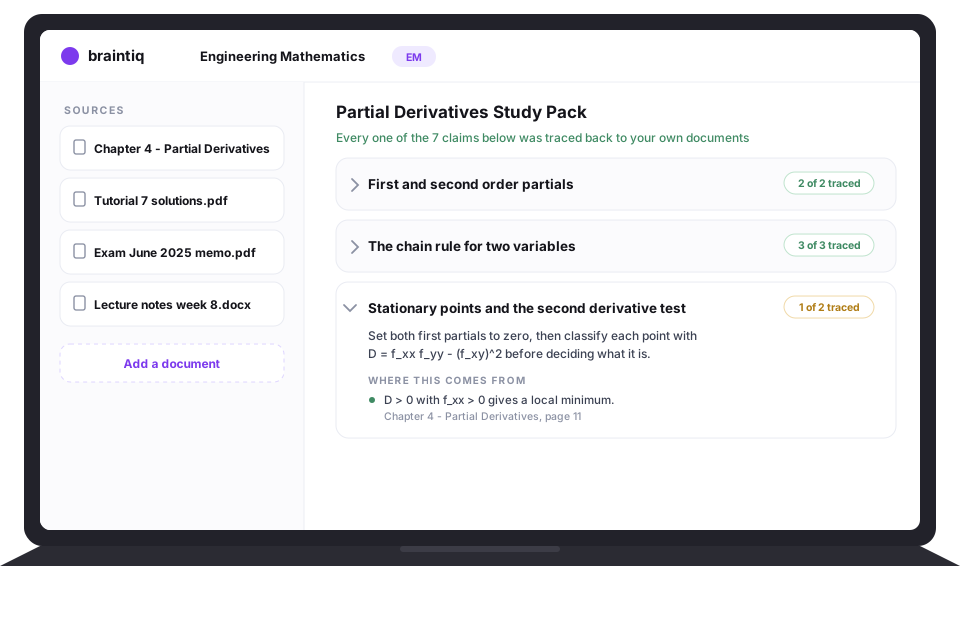
Every claim in a generated study pack carries the document and page it came from, and the ones that could not be traced are shown and marked rather than hidden. In physics that matters more than in most subjects, because a confidently worded wrong statement about acceleration at the top of a trajectory is exactly the kind of thing that survives revision unnoticed.
You can use it without an account at braintiq.app/try.
The short version
- Acceleration at the highest point of a projectile is $9.8$ downward, not zero.
- One free-body diagram per body, never one for the system.
- Action-reaction pairs act on different objects, which is why they do not cancel.
- Momentum is a vector. Choose a positive direction before substituting.
- Airbags work by increasing $\Delta t$, not by absorbing force.
- Work done by friction is always negative.
- Redraw the circuit before answering anything about it.
- Below the threshold frequency, brightness does nothing at all.