NSC Life Sciences: Knowing the Biology Is Not the Same as Answering the Question
by Braintiq Academic Team
Life Sciences has a particular kind of frustration attached to it. Students revise hard, know the material, sit the paper, and get a mark well below what they expected. The usual diagnosis is that they did not study enough. Usually it is not.
The real cause is that Life Sciences examines how you write an answer as much as what you know, and it does so more strictly than any other NSC subject. The memo is a list of specific required points, and an answer that contains the right idea in the wrong words frequently scores nothing.
That is fixable, and much faster than learning more content.
The instruction words are the instruction
Every question begins with a verb that tells you exactly what to produce. Students read past it to the topic and then write what they know about the topic.
- Name or State: one word or a short phrase. Nothing more. Writing a paragraph wastes time and earns no extra credit.
- List: several items, no explanation.
- Describe: say what happens, in order, in detail.
- Explain: say why it happens. An explanation that does not answer a why question has not explained.
- Discuss: present more than one side or consider several factors.
- Tabulate: draw an actual table with headings. A paragraph comparing the same things scores badly even when the content is right.
The single highest-value five minutes you can spend before the exam is being sure of these. They are worth marks in every question on the paper.
The mark allocation tells you the length
If a question is worth 3 marks, the memo has three separate points on it. Not one point explained at length.
So write three distinct things. If you are unsure, write them as three separate sentences or three bullet points, because a marker scanning for three points finds them faster and cannot miss one buried in a paragraph.
The reverse also applies. A 1 mark question wants one thing. Writing five sentences for one mark is time taken from the rest of the paper.
Terminology is not optional
This is the largest difference between Life Sciences and the other sciences. The memo frequently requires the technical term, and a correct description in everyday language earns nothing.
If the answer is "osmosis", writing "water moves through" does not score. If it is "vasoconstriction", writing "the blood vessels get smaller" does not score. If it is "negative feedback", "the body corrects itself" does not score.
Which means the highest-yield revision activity in this subject is building a terminology list per topic and drilling it. Homeostasis, osmoregulation, transpiration, translocation, meiosis, crossing over, non-disjunction, natural selection, speciation, eutrophication. Each of these is a specific word the memo wants to see.
Structuring a cause and effect answer
A very large share of Life Sciences marks sit in questions of the form "explain what happens when X" or "explain why Y occurs". These are chains, and the memo pays per link.
Take: explain what happens when blood glucose rises after a meal.
A weak answer says insulin controls it and the level comes down. That is one mark at best.
A full answer is a chain:
- The rise is detected by the pancreas.
- The pancreas secretes insulin.
- Insulin travels in the blood to the liver and muscle cells.
- Those cells take up glucose and convert it to glycogen.
- Blood glucose concentration decreases to normal.
Five links, and each is a mark. Write them as a numbered sequence. The structure makes you produce the whole chain rather than jumping from stimulus to outcome, which is what a weak answer does.
The same shape covers thermoregulation, osmoregulation, the menstrual cycle, phototropism and the reflex arc. Stimulus, receptor, message, effector, response. Learn the shape once and apply it everywhere.
Diagrams have their own rules
If asked to draw, the marks are for specific features, not artistry.
- Use pencil, and draw clear single lines rather than sketchy repeated ones.
- Label with straight lines that touch the structure and do not cross each other.
- Write labels horizontally, on one side where possible.
- Give the diagram a heading. This is a mark and it is skipped constantly.
- Include a scale or magnification if asked.
When asked to label a supplied diagram, the marks are purely for correct labels, so work through methodically rather than labelling only what you are confident about. An unlabelled structure scores zero and a wrong guess also scores zero, so there is no cost to attempting every one.
The data response questions
Every paper has questions built on a graph, a table or a described experiment. These are the most reliably scored marks on the paper for a prepared student, because they need reading rather than recall.
For a graph question, the answer is almost always in the graph. Quote actual values with units. "It increased" is weak. "It increased from 20 to 65 units between day 2 and day 6" is what the memo wants.
For an experiment question, three concepts come up repeatedly and are worth knowing precisely:
- Independent variable: what the investigator deliberately changed.
- Dependent variable: what was measured in response.
- Controlled variables: everything deliberately kept the same so the comparison is fair.
Asked why a control group was used, the answer is that it provides a comparison showing the result was due to the variable being tested and not to something else. Asked how to improve reliability, the answer is to repeat the experiment and use larger sample sizes. These are preparable sentences and they recur every year.
Paper 2 and the essay
The long question rewards structure heavily, and there are marks specifically for it.
Plan before writing. Three minutes of headings turns a rambling answer into a structured one and the structure itself carries marks in most memos.
Use subheadings matching the parts of the question. Write in full sentences, not bullet points, unless the question permits otherwise. Cover every part of the question asked, because an essay that treats one part beautifully and omits another cannot reach full marks.
Watch the mark split. If an essay is worth 20 and has two clear parts, roughly half your writing belongs to each.
Preparing efficiently
Build a terminology list per topic. Drill it with retrieval rather than re-reading. This is the highest-yield activity in the subject.
Practise the chains. For each process in the syllabus, write the numbered chain from memory. Stimulus, receptor, message, effector, response.
Do past papers and mark against the official memo, strictly. Do not award yourself a mark for having the right idea in the wrong words, because the marker will not. That strictness is uncomfortable and it is where the improvement comes from.
Braintiq works from your own documents. Upload your notes, past papers and memos into a subject space, and what it builds comes from those pages rather than from a general model of the syllabus.
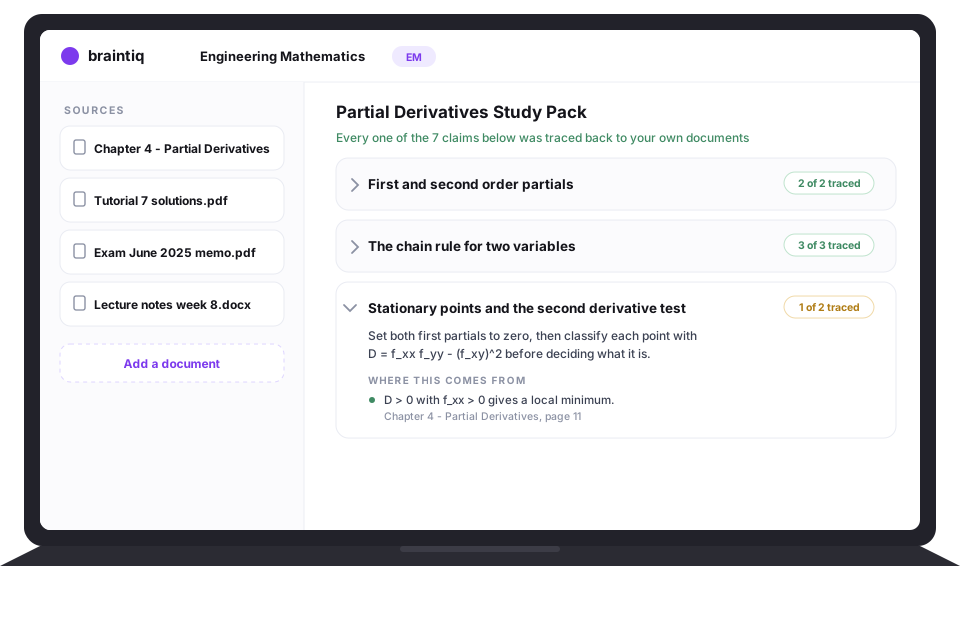
Every claim it makes carries the document and page it came from, and anything it could not trace is marked rather than quietly included. In a subject where the exact word is the mark, having the source available matters more than usual.
You can use it without an account at braintiq.app/try.
The short version
- Read the instruction word. Name, describe and explain want different things.
- The mark allocation is the number of points. Three marks means three separate points.
- The technical term is the mark. A correct description in ordinary words often scores nothing.
- Write cause and effect answers as numbered chains. The memo pays per link.
- Stimulus, receptor, message, effector, response covers most of the physiology.
- Diagrams need a heading, straight non-crossing label lines, and pencil.
- Quote real values with units from graphs.
- Know independent, dependent and controlled variables precisely.
- Mark yourself strictly against the memo. The right idea in the wrong words is not a mark.