First-Year Engineering Calculus: What Actually Changes From School
by Braintiq Academic Team
A specific thing happens in the first semester of an engineering degree in South Africa. Students who did well in matric maths, often very well, hit first-year calculus and struggle in a way that surprises them. They conclude they are not good at maths after all.
Usually they are wrong about that. What has happened is that four things changed at once, and nobody told them which four. This is an attempt to name them, and then to say what to do about each.
Change one: the pace roughly triples
A matric maths topic gets weeks. The same material at university gets a lecture, sometimes half a lecture.
Differentiation, which was most of a term in grade 12, is typically covered in the first two or three weeks of first year, including the rules you never saw at school, and then used as assumed knowledge forever after.
This is not a difficulty of content, it is a difficulty of scheduling, and it has a scheduling answer. You cannot learn a topic the week before the test any more, because by then four more topics have arrived on top of it. The work has to be kept current weekly or it compounds.
The practical version: do the tutorial for a lecture within about 48 hours of that lecture. Not the night before it is due. The reason is not diligence, it is that the lecture is still partly in your head at 48 hours and almost entirely gone at ten days, so the second version costs you two or three times as long.
Change two: you are expected to read
School maths is taught. University maths is partly taught and partly assigned, and the assigned part is not optional.
Most first-year engineering courses in South Africa use a standard calculus text, and the lecturer will move quickly on the assumption that you have read the section. The lecture then makes sense, because it is the second time you have met the idea rather than the first.
Reading a maths textbook is a different activity from reading anything else, and this is where students who have never been taught how get stuck. The method:
- Read with a pen and paper, never without.
- When the book does a worked example, cover the solution and try it first. Uncover one line at a time when stuck.
- When the book says "it follows that" or "clearly", it usually takes three lines of algebra. Do those three lines yourself in the margin. That phrase is where textbooks hide the work.
- Do not read to the end. Read until you are lost, then stop and work out what you missed. Reading past the point of confusion produces pages covered and nothing gained.
Twenty minutes of that is worth two hours of reading passively.
Change three: limits and rigour arrive
At school, a derivative was a rule you applied. At university, somebody insists on telling you what it actually is, and the definition involves limits.
$$f'(x) = \lim_{h \to 0} \frac{f(x+h) - f(x)}{h}$$
Matric touched this as "first principles" and then moved on. First year does not move on. You get epsilon-delta definitions, continuity, differentiability, and proofs that a thing you have been using for two years is true.
Students often treat this as pointless ceremony before the real work. It is the opposite: it is the part that makes everything later possible. The reason you can differentiate a function you have never seen before is that the rules were proved in general rather than demonstrated on examples.
The practical advice is to not skip the theory lectures because "the tutorials are what is examined". In most courses the theory is examined too, usually as "state the definition" or "state the conditions under which this theorem applies", and those are among the most reliably scored marks on the paper for anyone who prepared them.
Change four: nobody checks whether you did the work
This is the one that decides outcomes more than the other three.
At school, someone notices. A teacher marks your book, a parent asks, a class of thirty means your absence is visible. At university, a first-year engineering lecture can hold four hundred people and nobody will notice if you are not there, or if you are there and not following.
The systems that replace being checked on are entirely yours to build, and they should be simple enough to survive a bad week:
- A fixed weekly slot for each module's tutorial, in your calendar, treated as unmissable.
- A record of which tutorial questions you could not do, so the list of gaps is written down rather than vaguely felt.
- One session a week that is only revisiting older material, not this week's.
That last one is the one most students skip and the one that matters most, because of how forgetting works.
The thing about forgetting
The research on spaced practice is unusually consistent, and it says something counterintuitive: the sitting where you have half forgotten the material is the valuable one.
If you review something while it is still fresh, the review is easy and does very little. If you review it when it has faded and you have to reconstruct it, the reconstruction is what makes the memory durable. Difficulty during practice feels like failure and is actually the mechanism.
The consequence for how you study: doing sixteen problems on one topic in one evening feels productive and mostly trains your ability to do that topic while warmed up. Four problems today, four in three days, four next week, four a fortnight later is harder, feels worse, and works better.
The same applies to lecture material. A twenty minute pass over last week's lecture, from memory first and notes second, is worth more than rereading this week's twice.
What to do in the first two weeks specifically
Find out the assessment structure. How much is the exam worth, how much is class marks, what the subminimum is, and whether there is a compulsory tutorial component. Engineering programmes often have a subminimum you must reach in the exam regardless of your class mark, and students discover this in November.
Identify the gaps from school immediately. If exponents, logs, trigonometric identities or factorisation are shaky, fix them in week one while the course is still on revision material. Every one of these will be assumed, without warning, in about week four.
Find the tutors and go. Most engineering faculties run tutorial sessions staffed by senior students. Attendance is usually optional and usually correlates strongly with passing. The students who go are not the ones who need it most, which is exactly the problem.
Start a gap list. One page, one line per thing you could not do. Revisit it weekly. The value is that it converts a vague feeling of being behind into a finite list, and a finite list can be finished.
Using your own materials
The most useful study material you have is not a textbook, it is your own course: the lecture slides, the tutorial sheets, the past papers your department sets. They tell you what this lecturer examines, which is narrower and more specific than what the subject contains.
That is the principle Braintiq is built on. You upload your own lecture notes, tutorials and past papers into a subject space, and what it produces is built from those documents rather than from a general model of first-year calculus.
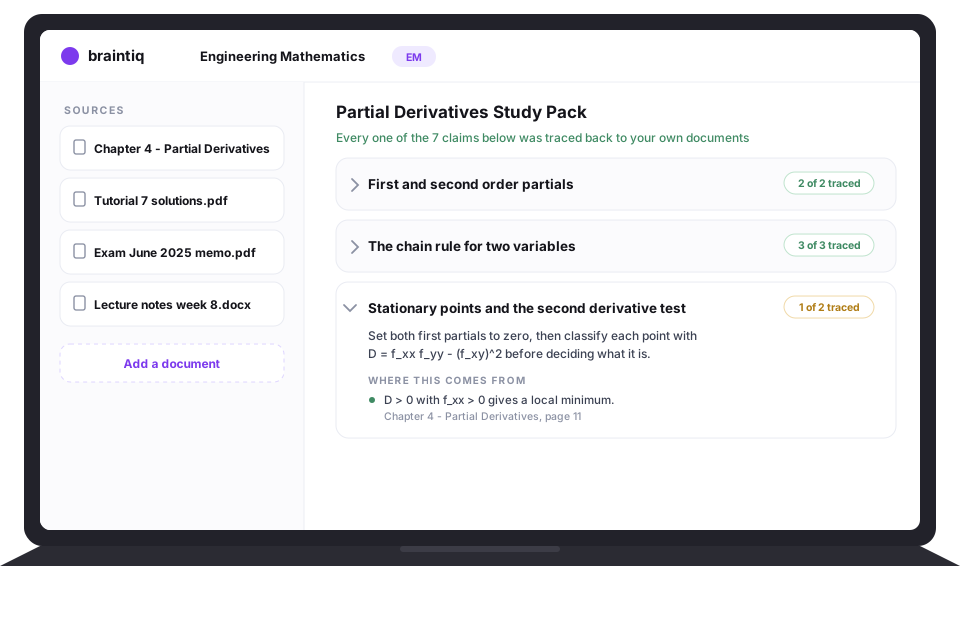
Every claim in a generated study pack carries the document and the page it came from, and anything that could not be traced is marked rather than hidden. For a subject moving as fast as first-year calculus that matters, because you do not have time to discover in November that something you revised in March was invented.
You can use it without an account at braintiq.app/try.
The short version
- The pace roughly triples. Do each tutorial within 48 hours of its lecture.
- You are expected to read the textbook, with a pen, stopping when lost.
- The theory is examined, usually as definitions and conditions. Do not skip it.
- Nobody will notice if you fall behind. Build the checking system yourself.
- Review when you have half forgotten, not while it is fresh. The difficulty is the mechanism.
- Fix your school-level gaps in week one, before they are silently assumed in week four.
- Find out the subminimum before November.
- Your own course materials beat any general resource, because they tell you what this lecturer examines.